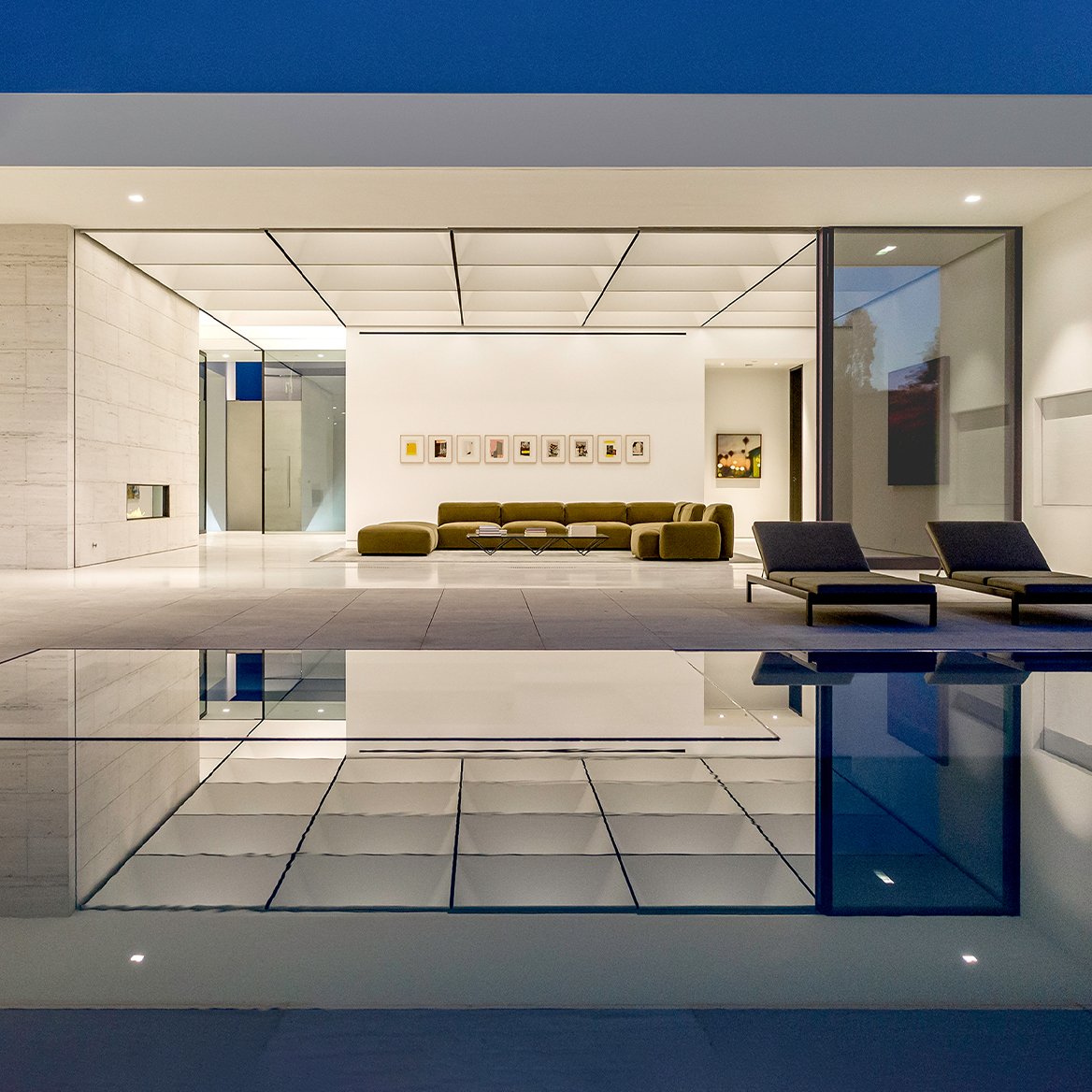
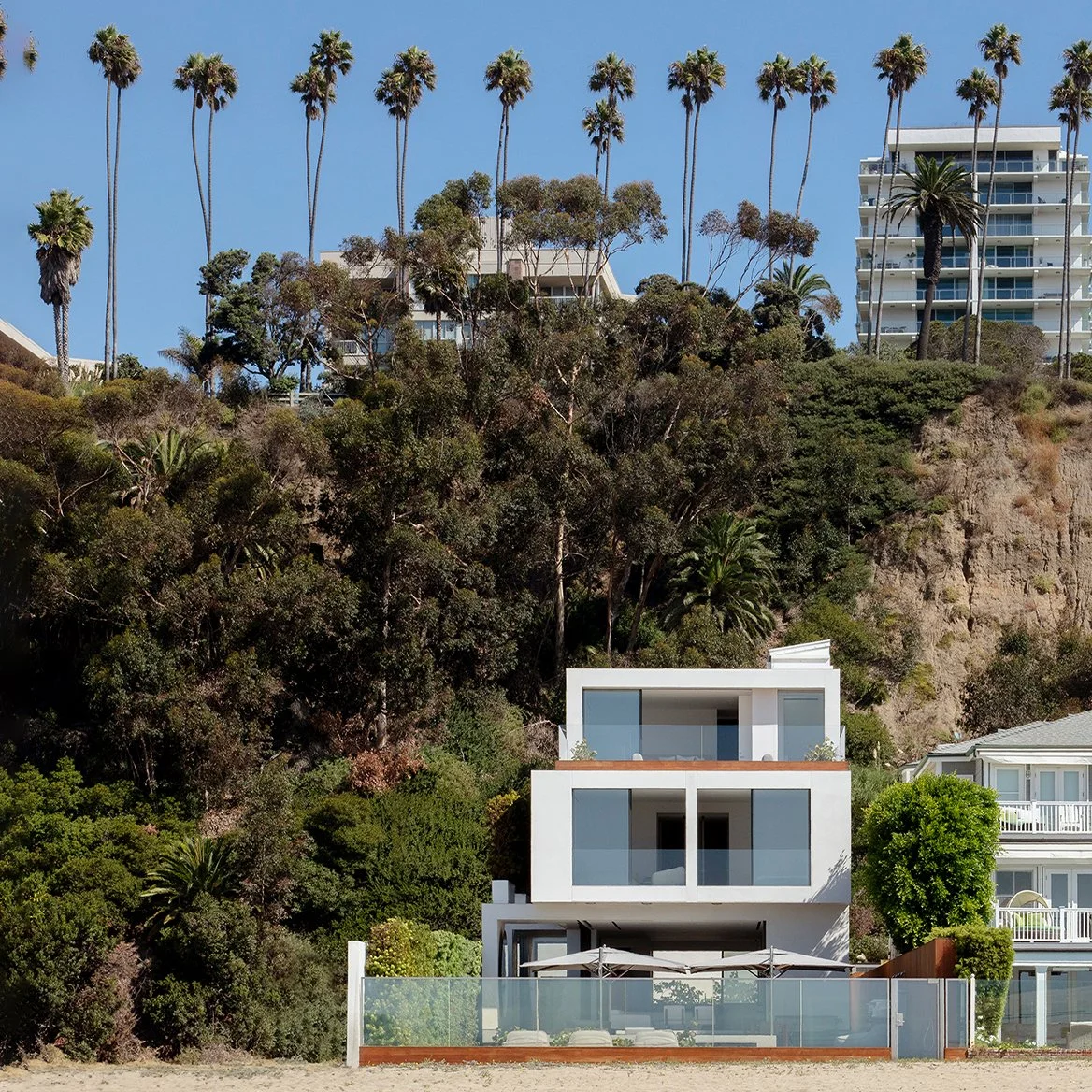
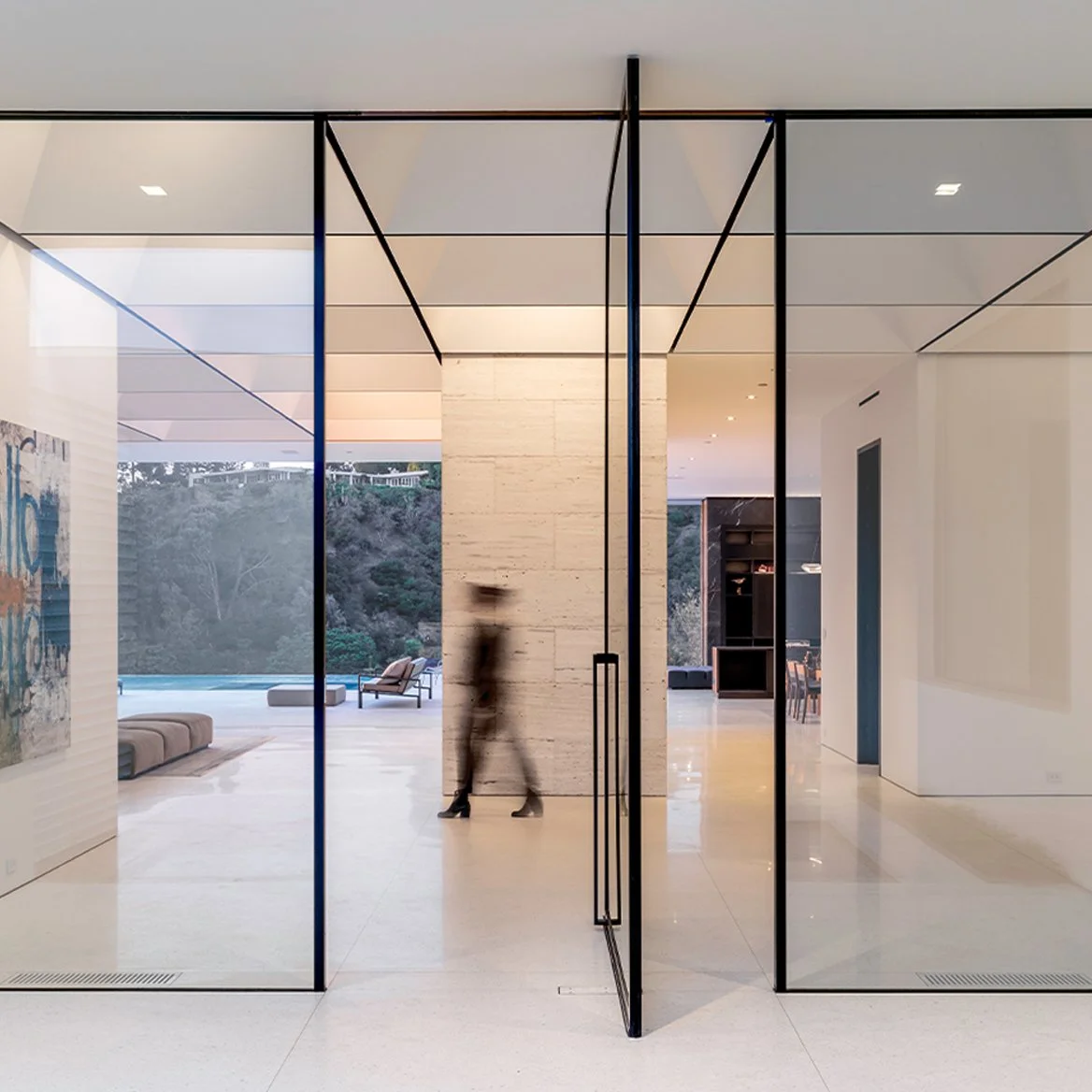
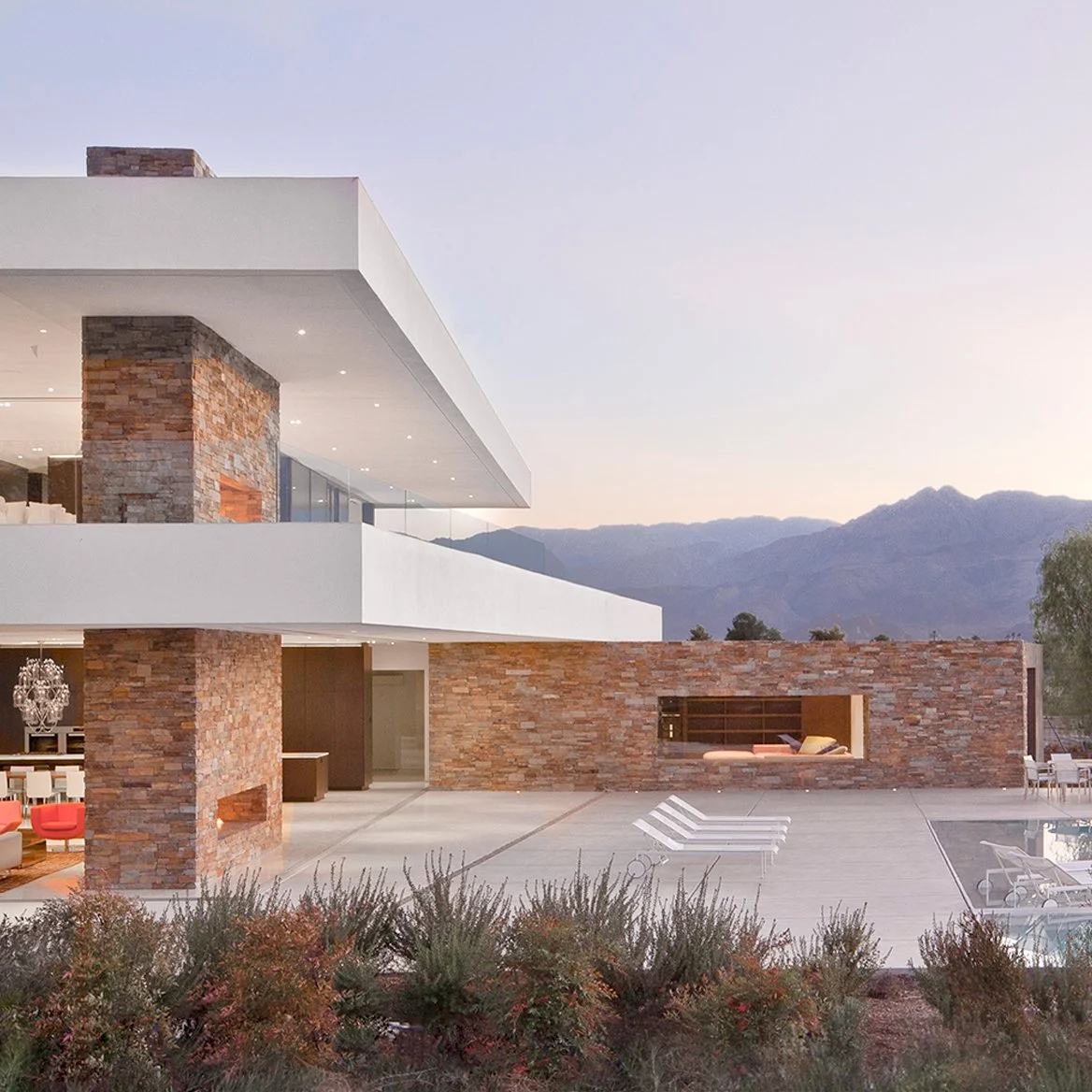
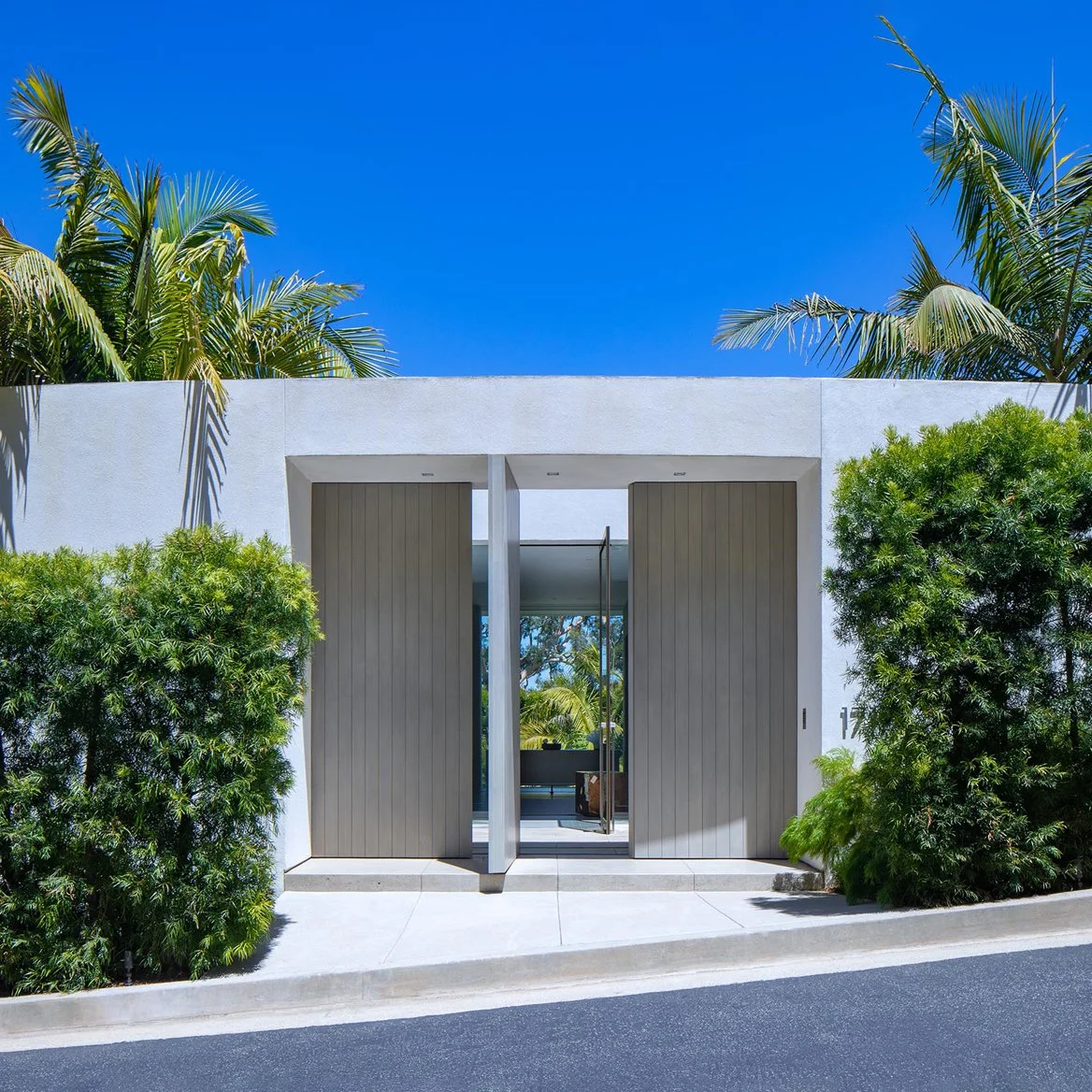
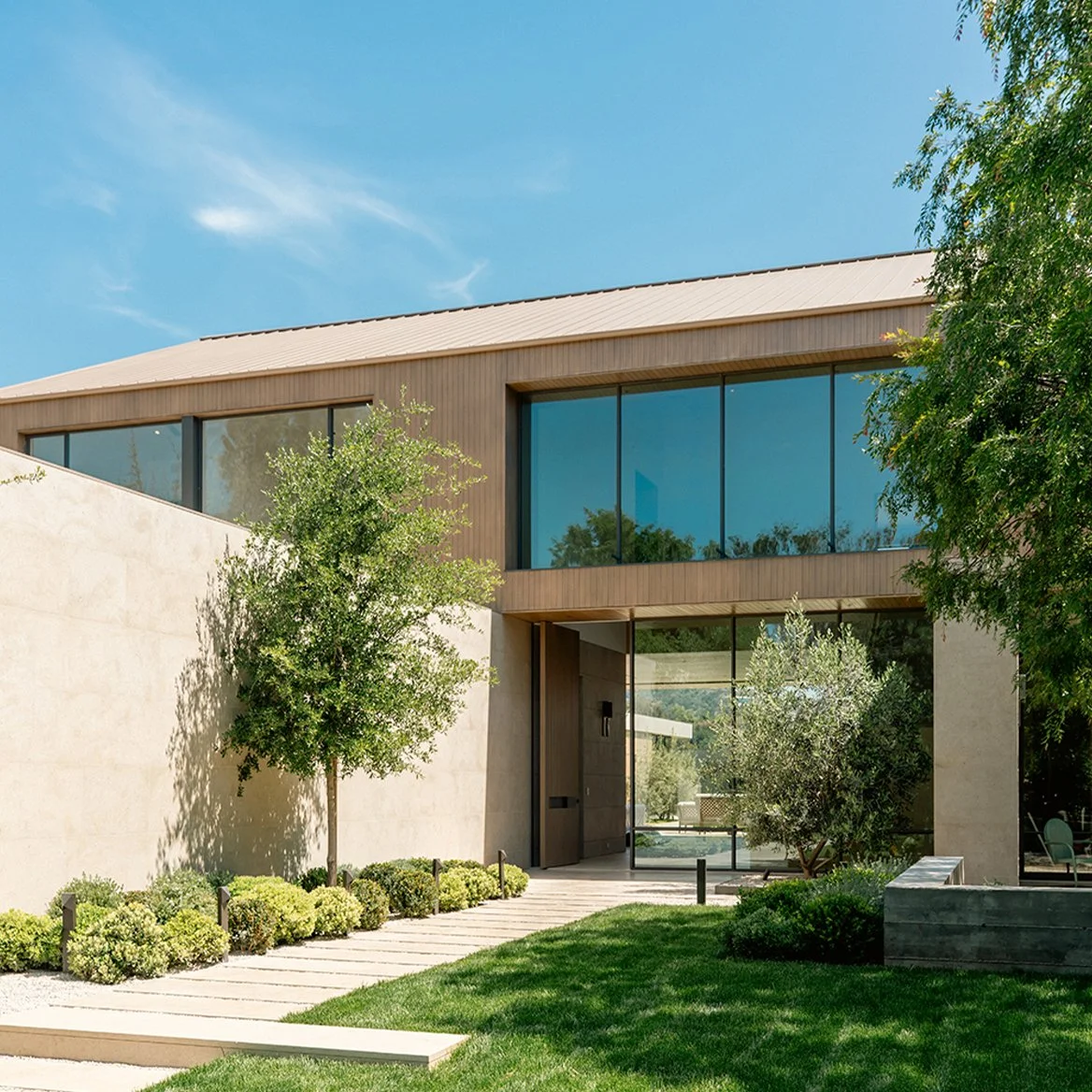
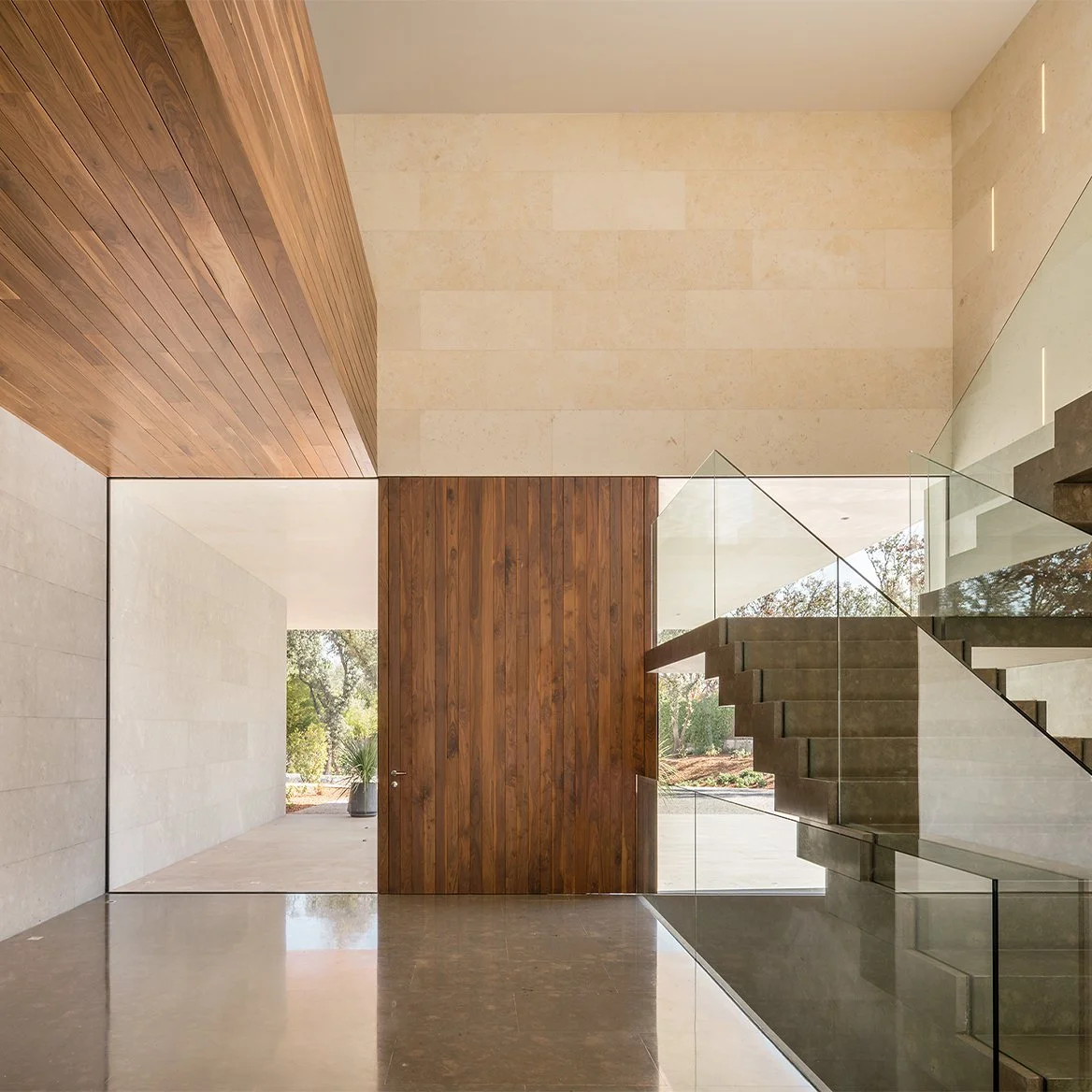
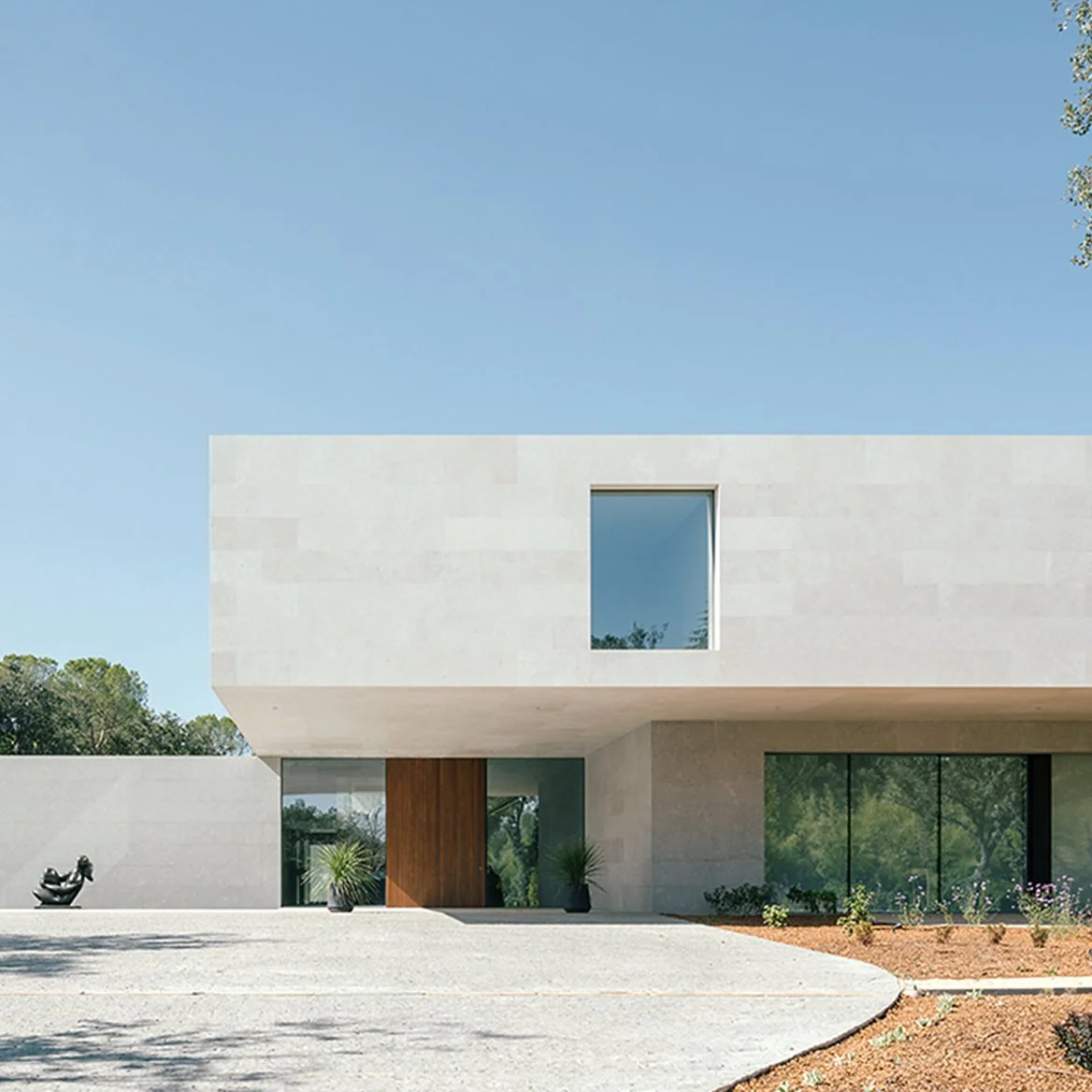
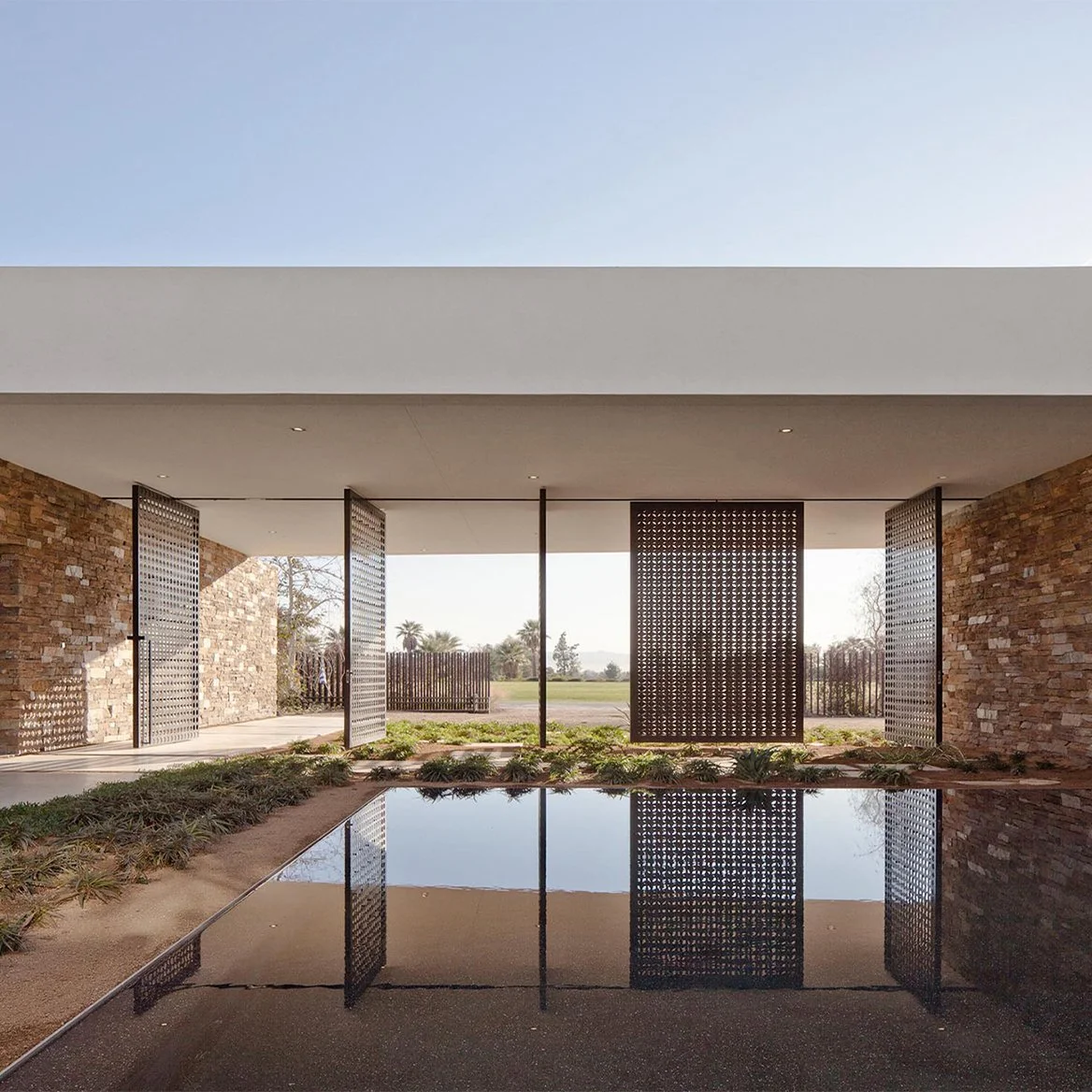
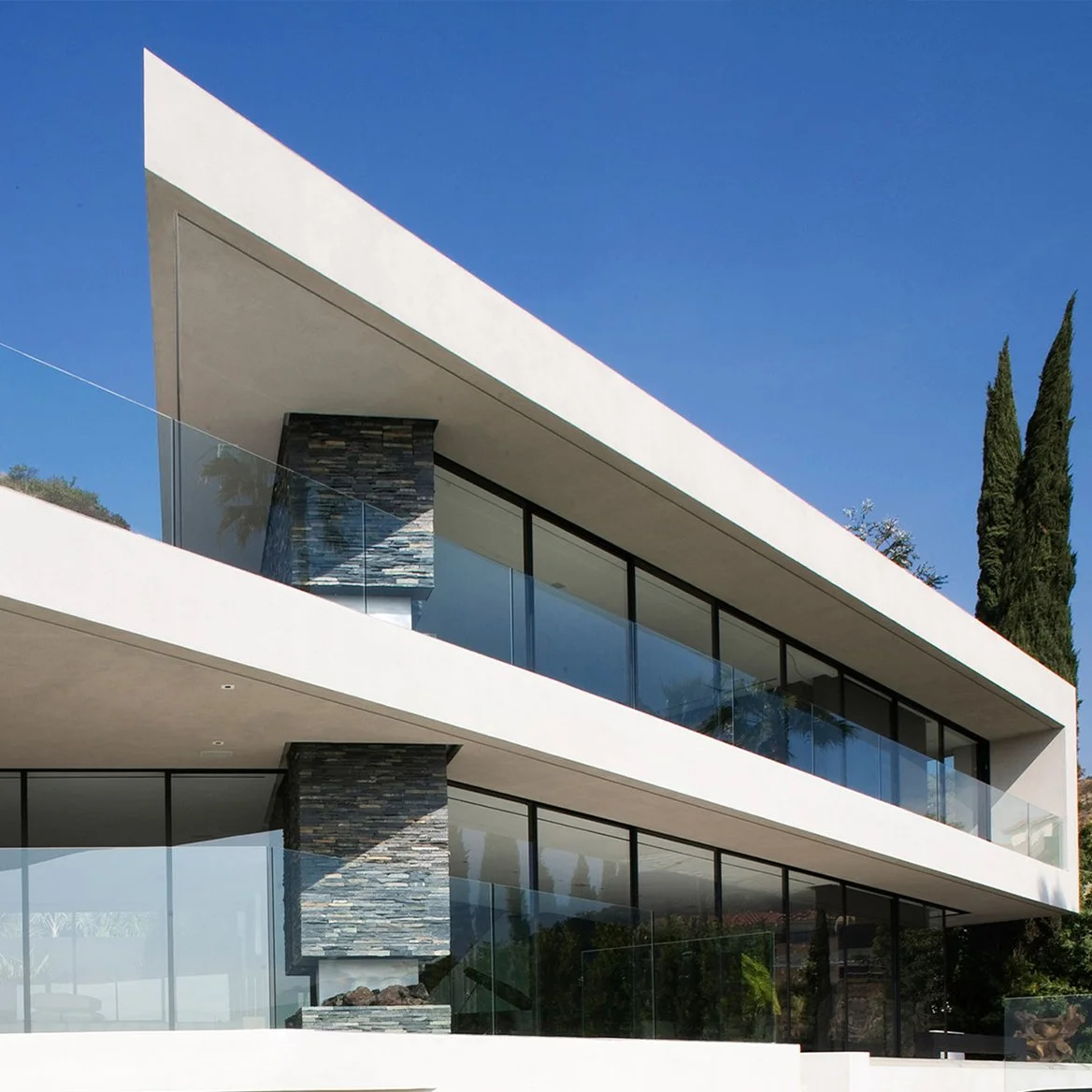
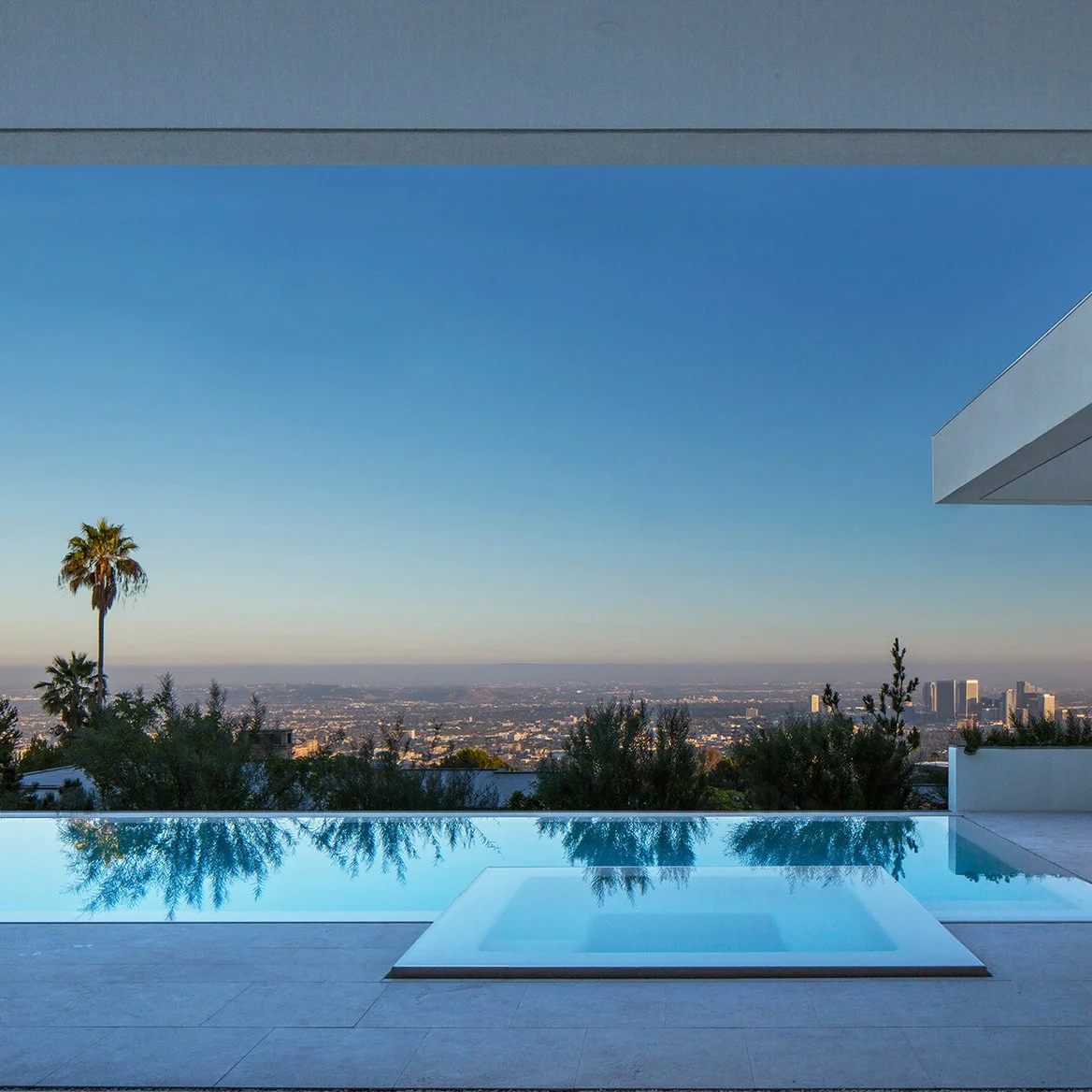
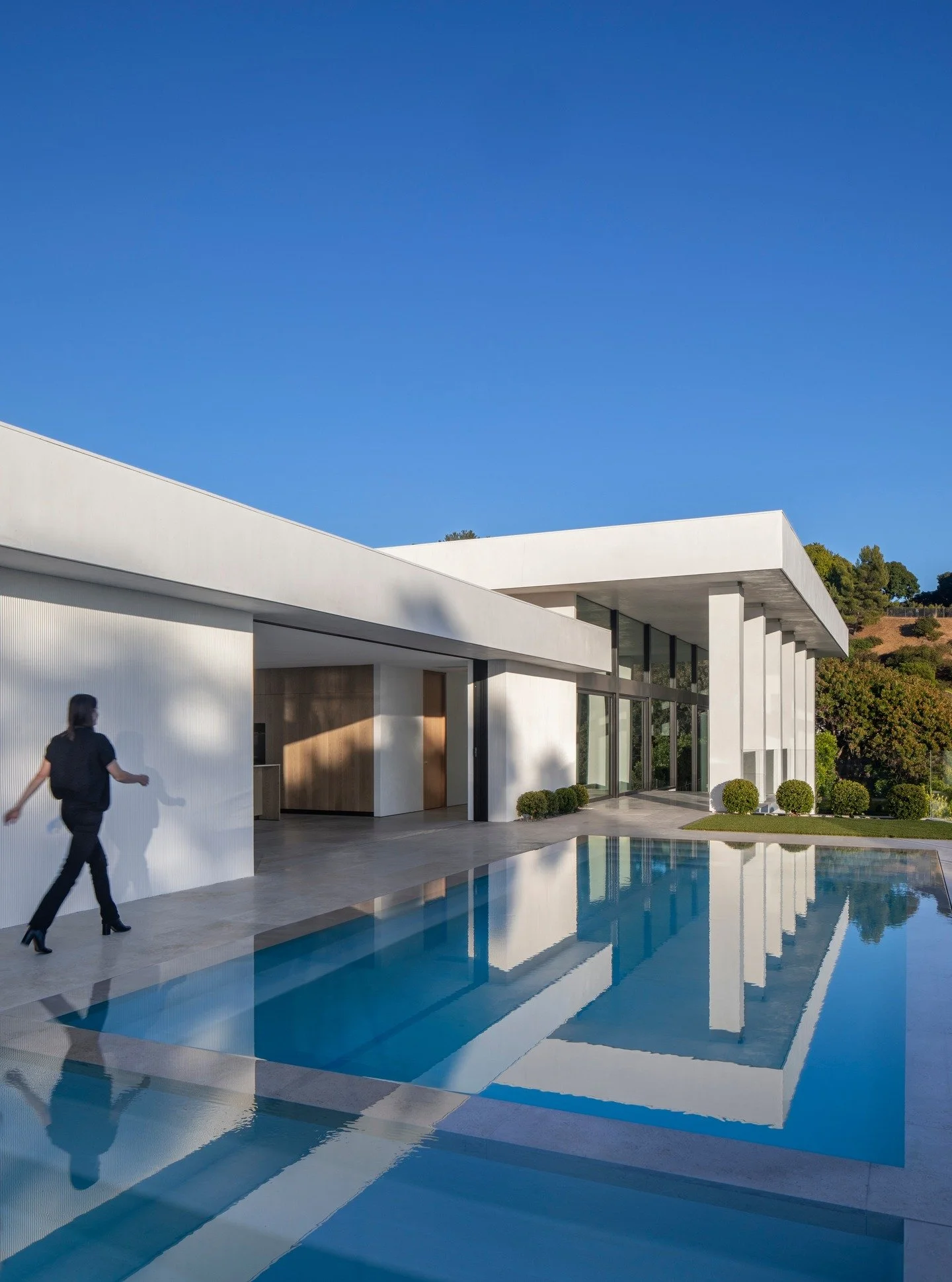
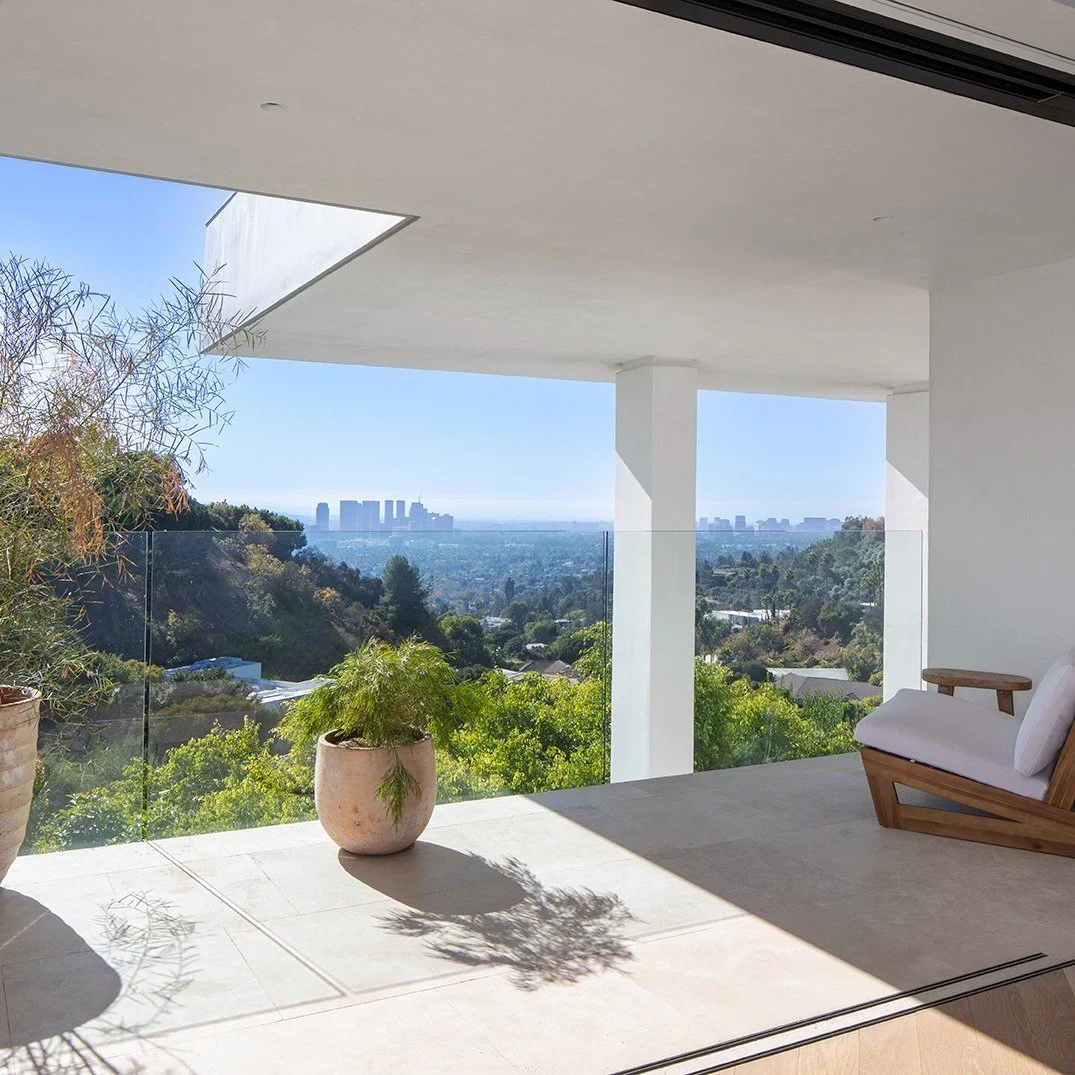
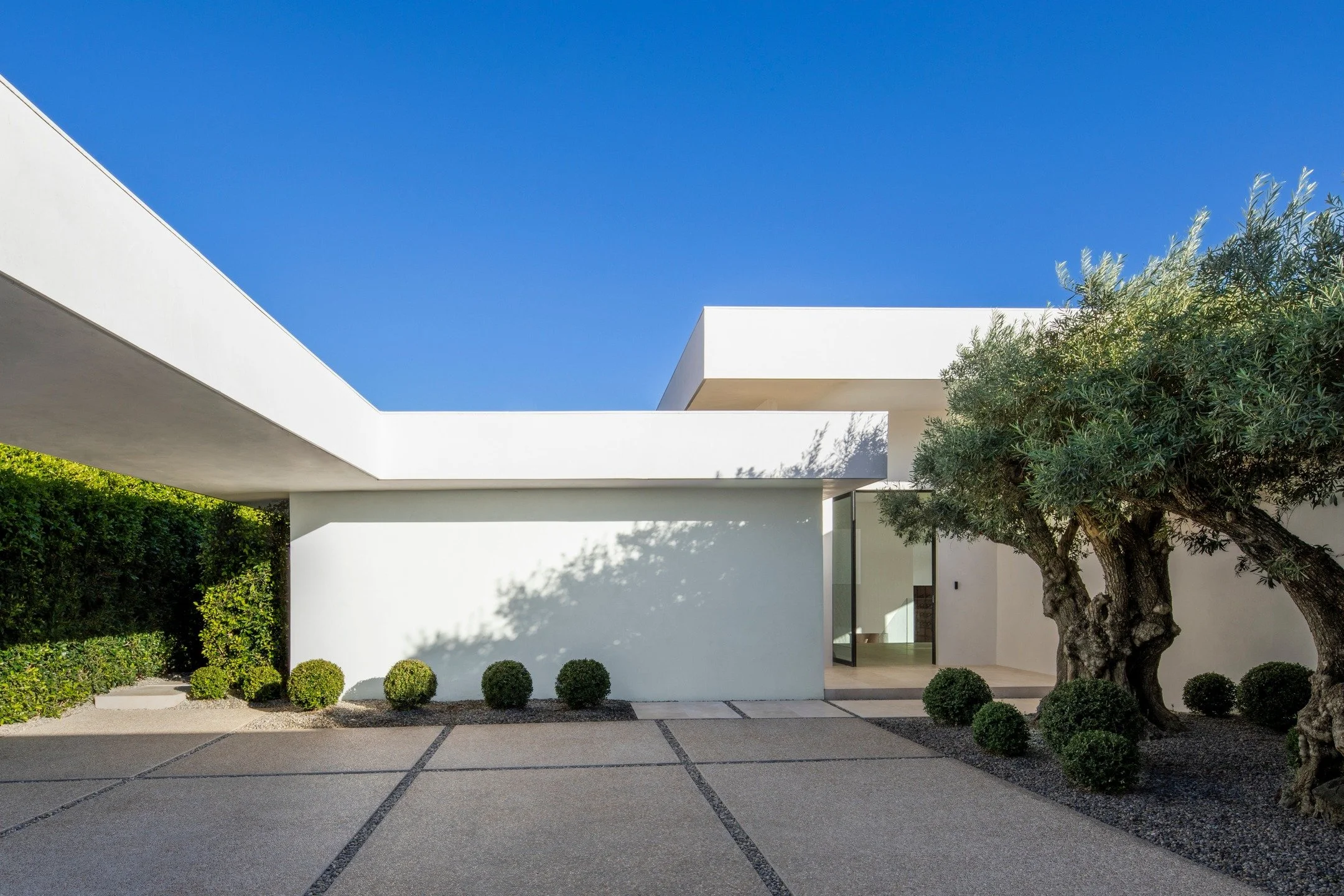
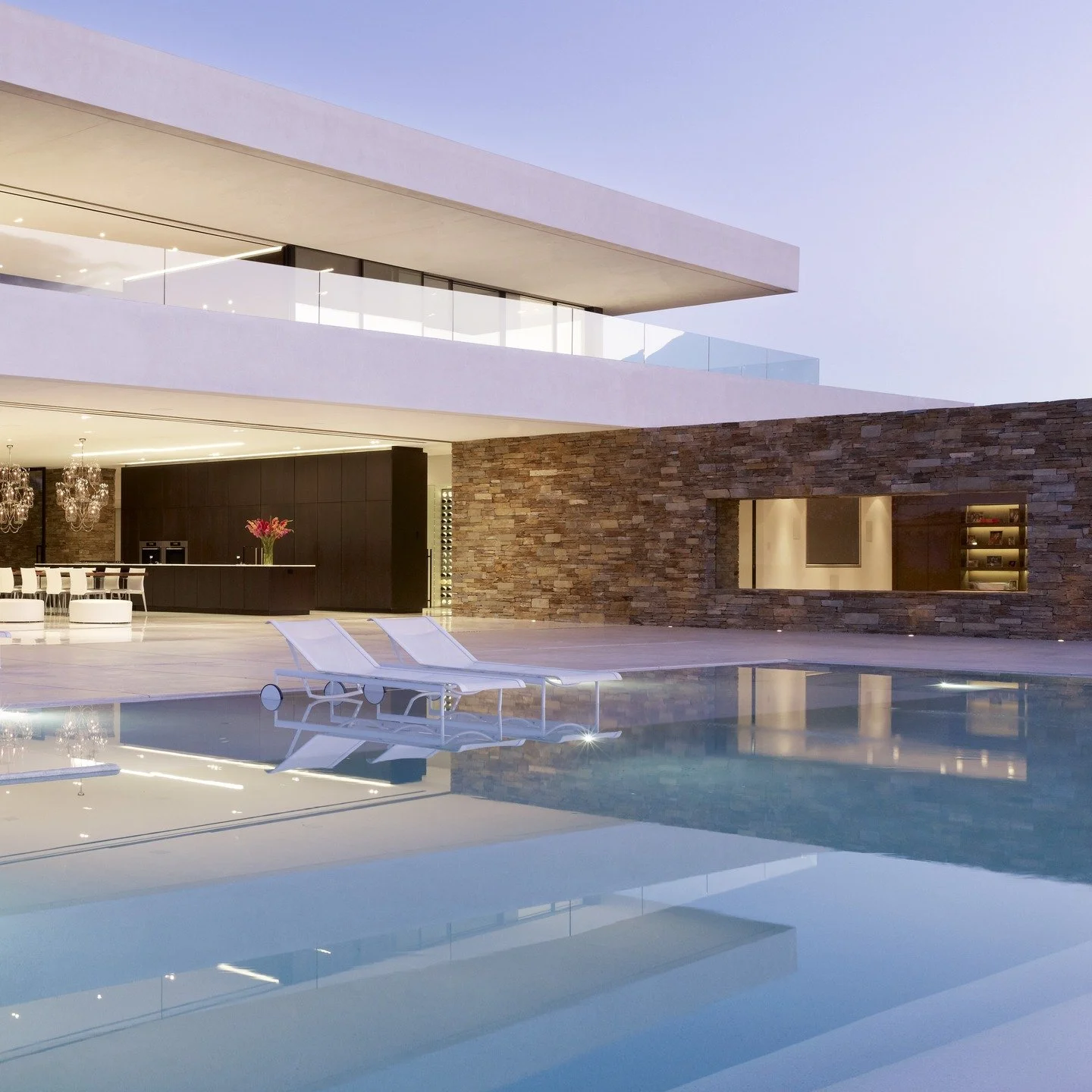
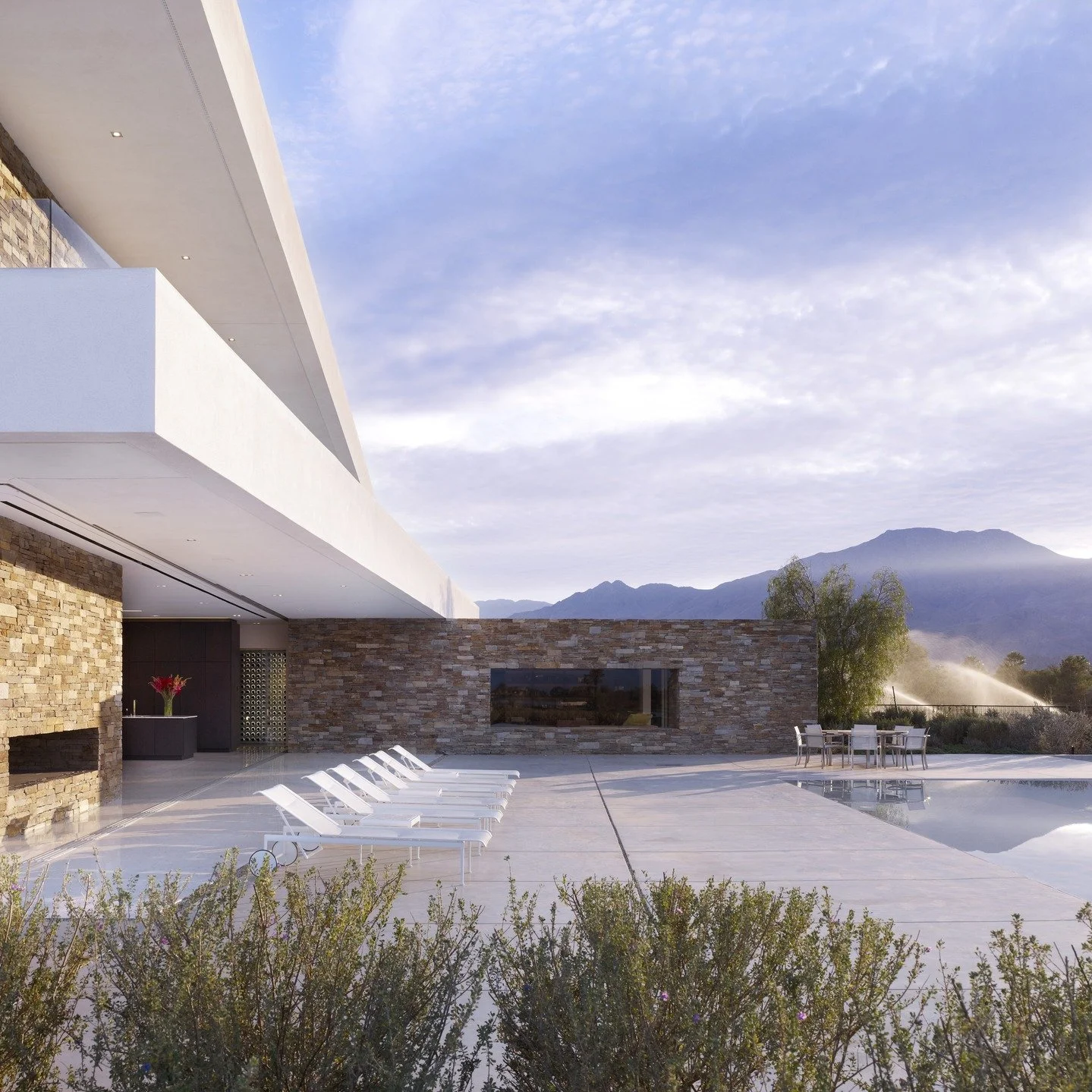
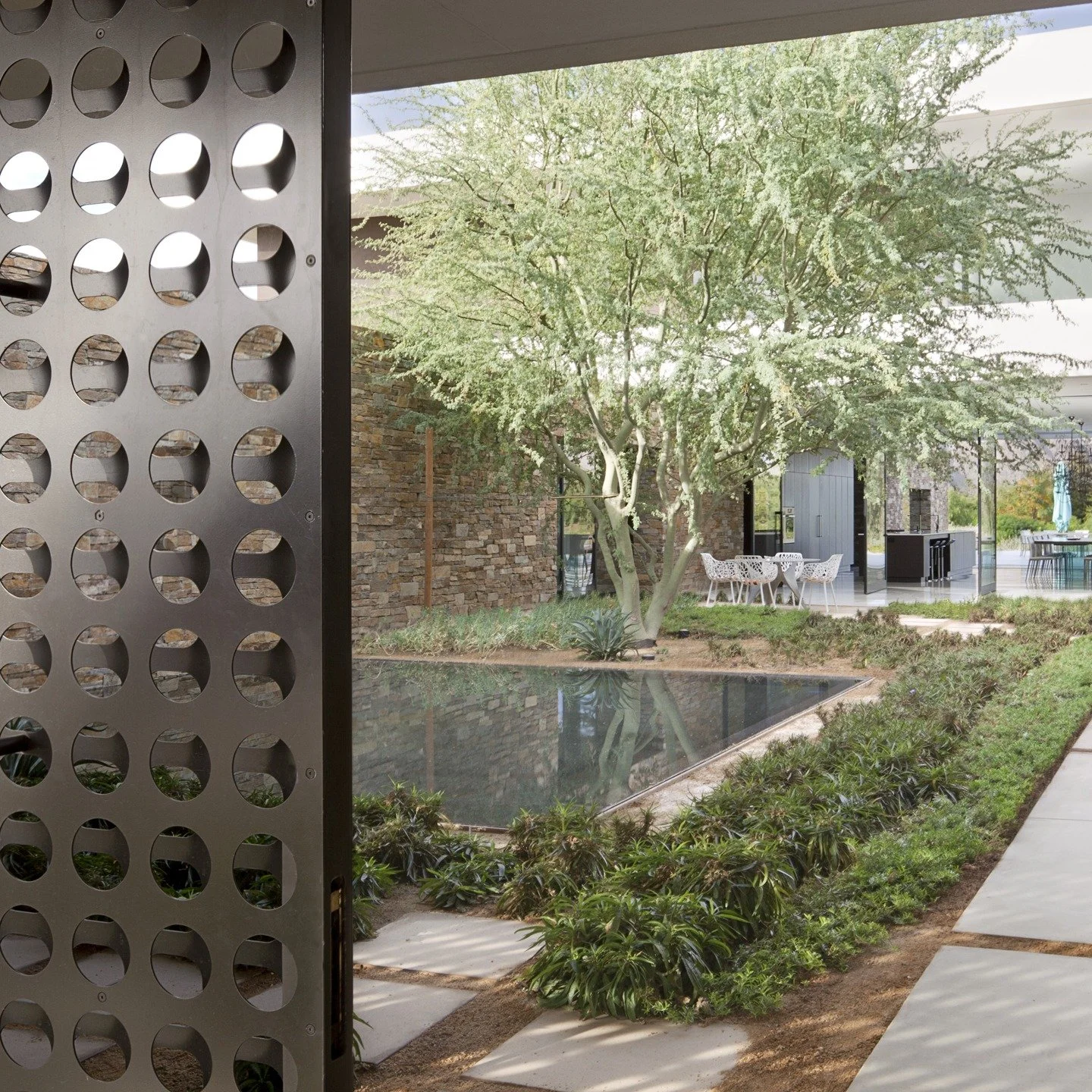
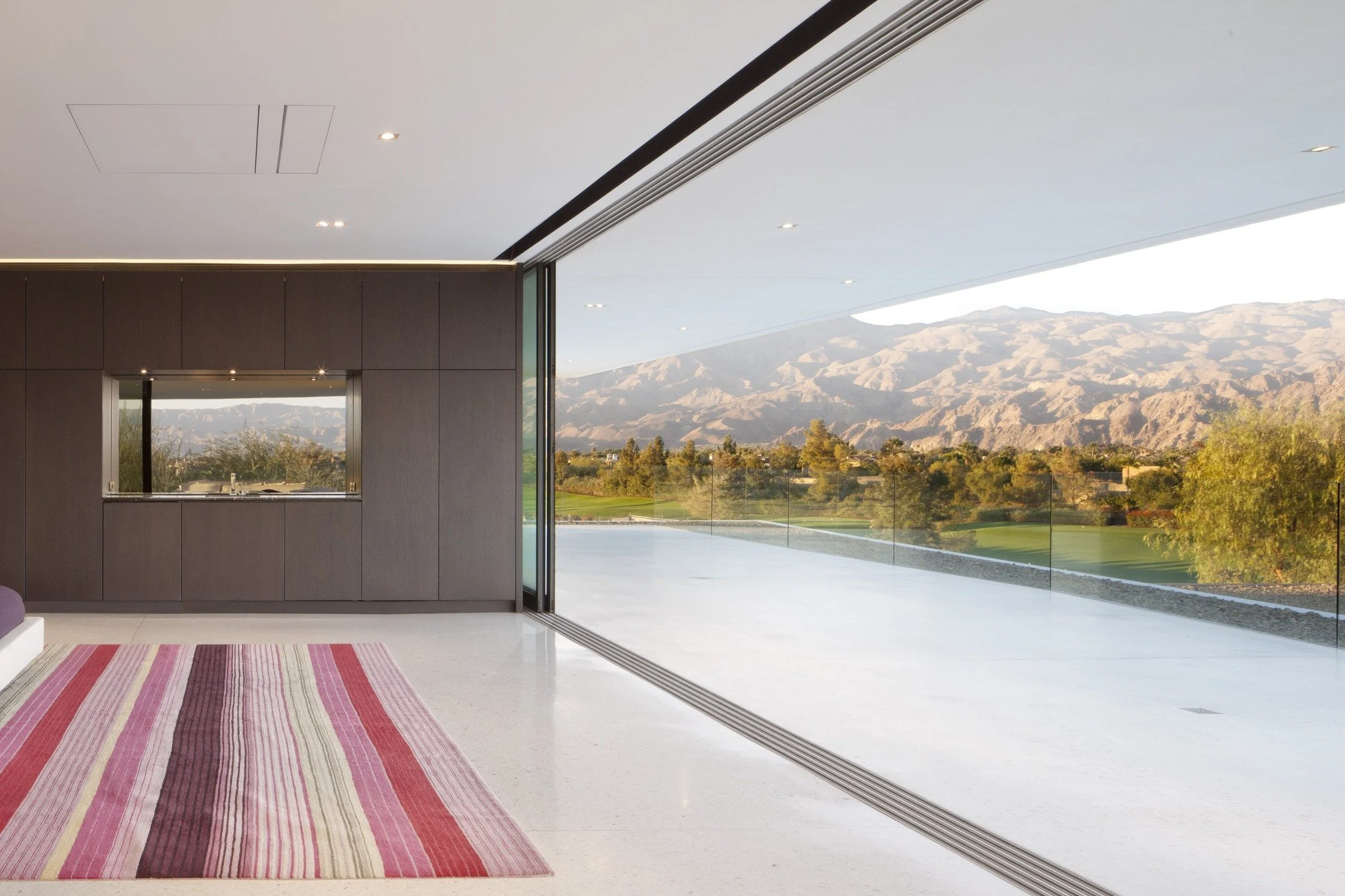
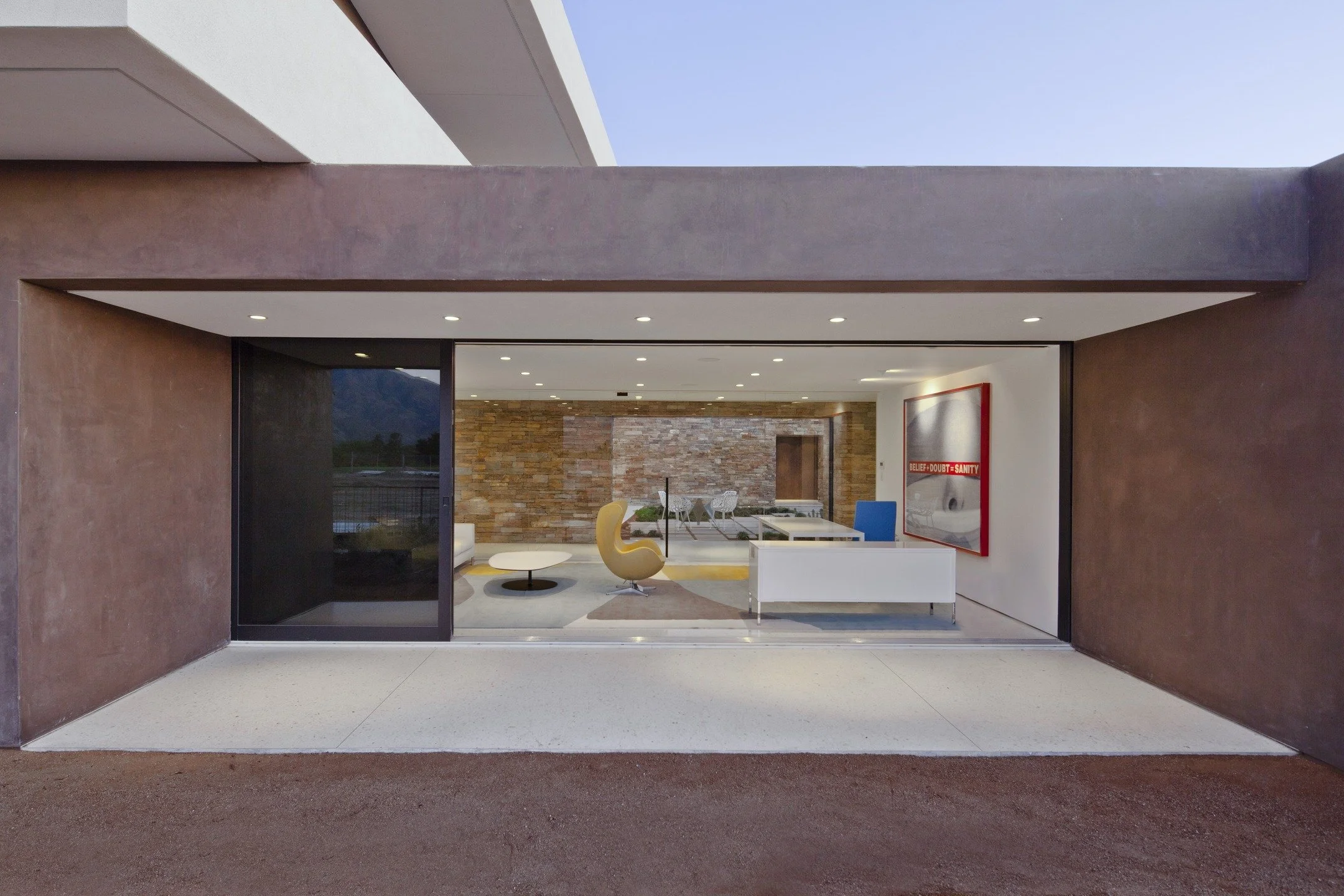
The Openhouse is embedded into a narrow and sharply sloping property in the Hollywood Hills, a challenging site that led to the creation of a house that is both integrated into the landscape and open to the city below. Retaining walls are configured to extend the first floor living level into the hillside and to create gardens on two levels. The front, side and rear elevations of the house slide open to erase all boundaries between indoors and out, connecting the spaces to gardens on both levels.
Glass, in various renditions, is the primary wall enclosure material. There are forty-four sliding glass panels, each seven feet wide by ten feet high and configured to disappear into hidden pockets and allow for uninterrupted views and access to exterior terraces and gardens. There are also fixed glass walls, mirror glass walls and light gray specular glass panels which lend lightness to the interior spaces.
The glass walls are visually counterweighted by sculptural, solid elements in the house rendered in stone, dark stained oak, tinted concrete and plaster. The use of cut pebble flooring throughout the house, decks and terraces continues the indoor-outdoor materiality, which is amplifed when the glass walls slide away. The building finishes are few in number but applied in a multiplicity of ways throughout the project, furthering the experience of continuous open spaces from interior to exterior.
Set in a visible hillside area above Sunset Boulevard, the Openhouse appears as a simple folded line with recessed glass planes, a strong sculptural form at the scale of the site. The minimalist logic of the architecture is transformed by direct and indirect connections to nature. With the glass walls completely open the house becomes a platform defined by an abstract roof plane, a palette of natural materials, hillside, gardens and the views.
Silverspur is a 30,000 square foot renovation to a modernist office building located on the Palos Verdes peninsula in Southern California. On the interior small offices were removed to create large, open loft spaces and sustainable design elements were integrated. On the exterior a new façade was developed to both increase the energy efficiency of the building and create a transformative new building image.
A green roof was added to provide thermal mass and insulate the interior from solar gain, which also provides storm water collection and percolation on site, reducing additional loads into the storm drain system. Radiant heat was added below the new concrete topping slabs to reduce reliance on the forced-air heating system. New high-efficiency fixtures and equipment, recycled carpeting and tile were added throughout the building, and full height vision glass was used to maximize daylight and reduce the need for artificial light.
The building façade is composed of perforated, micro-laminated solar fabric stretched over steel frames that are anchored to the cantilevered concrete building slabs at various angles depending on solar orientation and building program. The solar fabric reflects 80% of the incoming solar gain while allowing for full transmission of natural daylight. From inside the building one has complete vision of the landscape and city beyond. The cladding also changes throughout the day depending on the position of the sun, appearing opaque in the direct sun and translucent as the sun moves oblique to the façade.
The Sapphire Gallery is a residential addition designed to display a private collection of contemporary art while also providing for a home office with views to the surrounding hills.
The new structure is grafted onto the circulation spine of the existing house and lifted off the ground to provide a minimal footprint. Freeing the ground plane creates a new multi-functional hardscape/landscape area for the family that they use as carport, children's play area, for art parties and video projections.
A structural system of lightweight braced frames was developed which were factory built and assembled by crane in one day. These trusses rest upon moment frames that clear span the open ground plane in the perpendicular direction, and the floor and roof diaphragms are infilled with typical 2x wood framing. The system proved to be a remarkably simple, flexible and cost-effective way to achieve the program parameters of the project.
The remaining details are simple and direct: nail on casement windows, quartz pebble flooring, steel stairs and railings with perforated panels, infill walls of gypsum board with floor to ceiling pivot doors, full height glass with a ceramic coating for UV and solar protection. An array of photovoltaic cells on the South facing sloped roof produces an average of 15kWh per day, enough to supply all the energy for the new building with a surplus directed towards the main house.
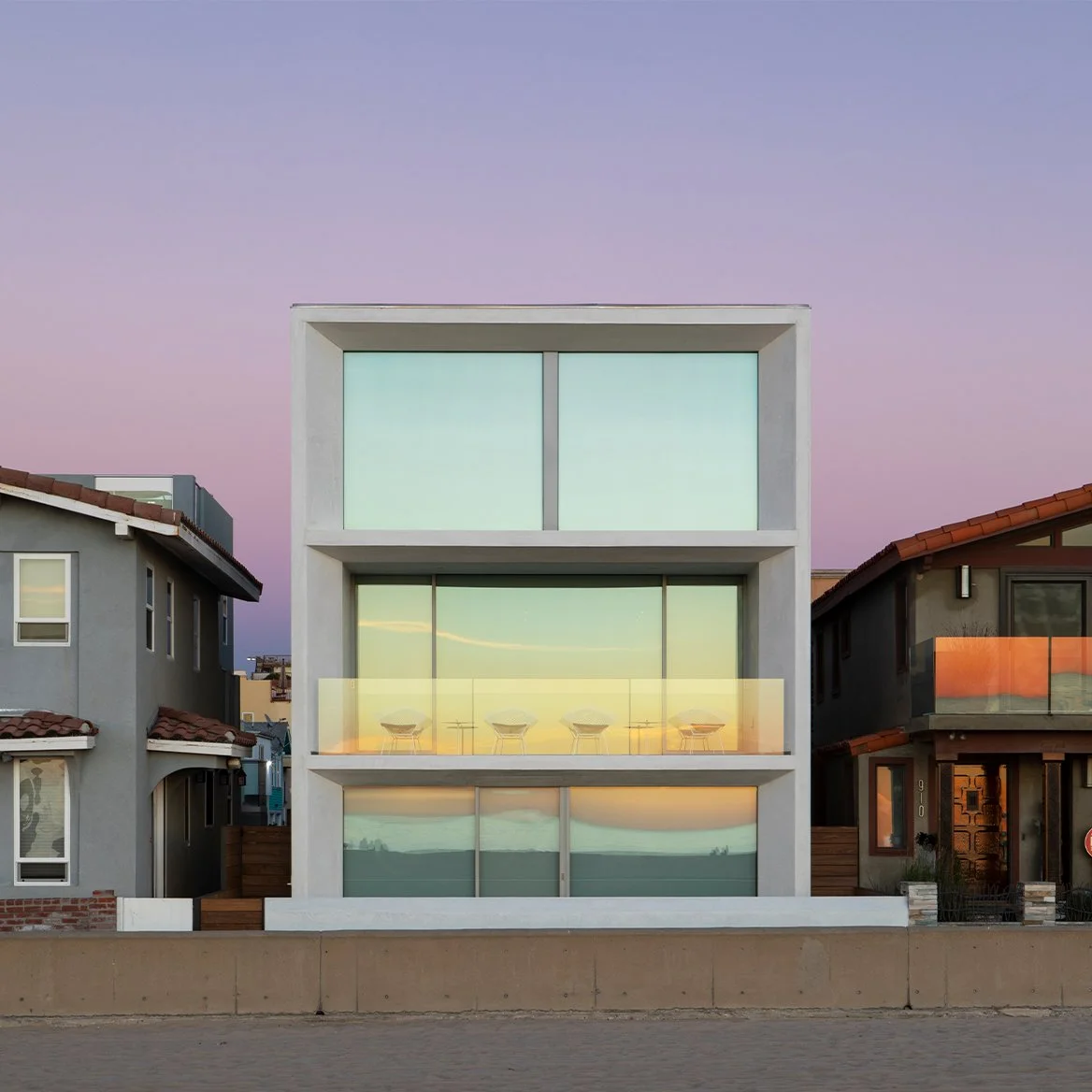
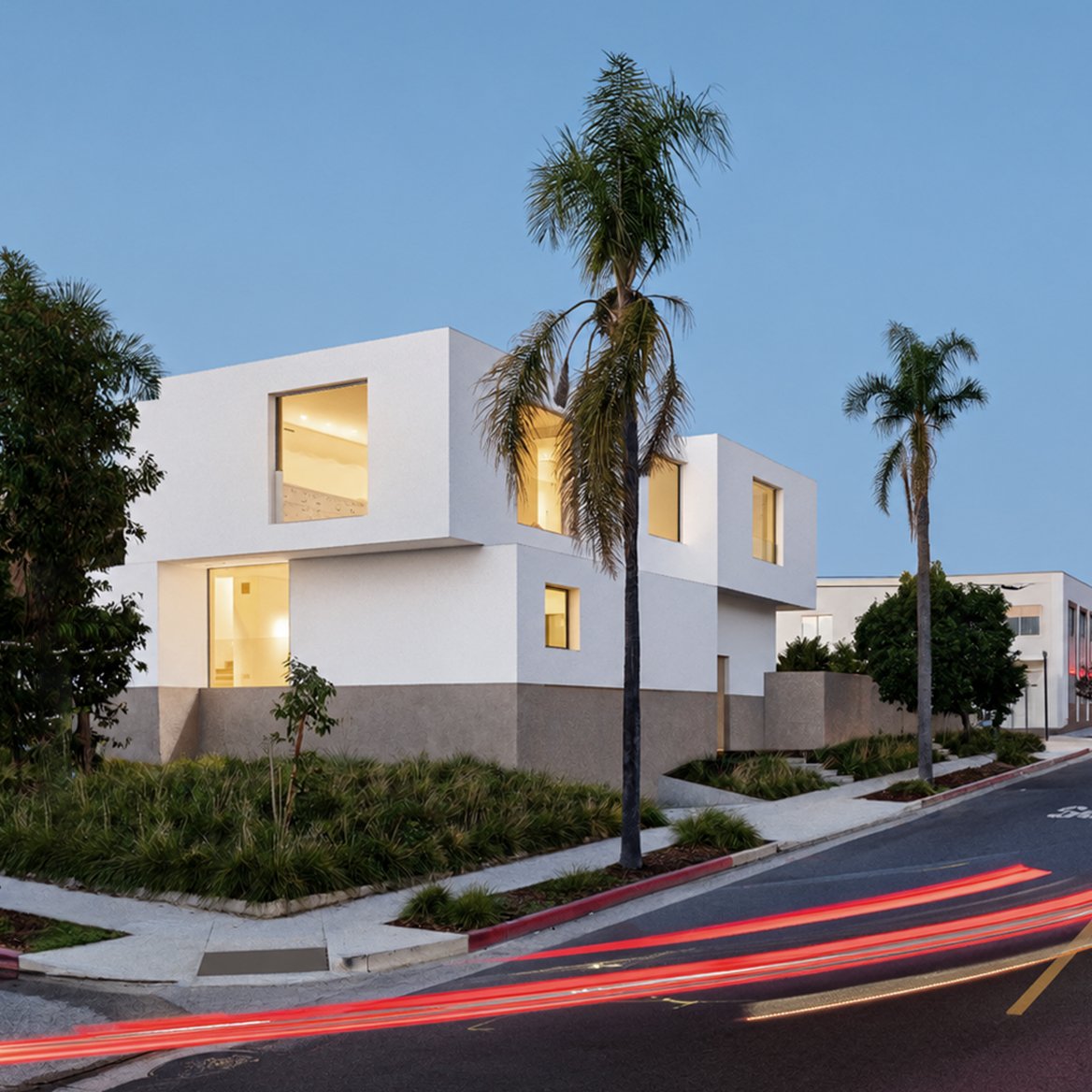
The Surfhouse sits like an abstract block of weathered wood a few blocks from the Pacific Ocean in Hermosa Beach. The site is incredibly small. Subtracting for setbacks leaves an allowable building area that is only 23-feet wide x 29-feet deep x 30-feet high. The architectural concept maximizes space, light and views while also creating a sense of privacy and retreat for the owners, a young couple, on a busy beachside street.
The domestic program is stacked vertically on the lot. Services and bedrooms are on the lower floors, with larger rooms pushed to the corners of the building envelope around a circulation core. This allows the top floor and decks to be a completely open continuous indoor/outdoor living space, open to views and an ocean breeze.
From the exterior the building has an abstract, opaque quality, like a piece of wood that has washed up on the beach. Over time the ocean winds and sand will wear grooves into the cedar and the sun will create subtle shifts in its coloring, relating the building more closely with its natural environment than with its man-made context.
Himmelrain is a series of nine apartment buildings set in a small town near Basel, Switzerland. In order to maintain the natural beauty, sightlines and access through the site, a planning strategy developed to evenly distribute many small buildings across the site rather than create fewer large buildings or conventional courtyard blocks.
The staggered, irregular distribution of buildings loosely fits the contingencies of the site and maintains public access and sight lines to the surrounding countryside. There are five units per building, each developed with adjustable, non-structural partition walls wrapped around a compact core. The buildings themselves are conceived as a stack of different materials... each responding to specific adjacencies and site conditions.
The garden maisonette units are masonry, with deep-set bronze windows for privacy and glass walls that slide away so the facades to open directly to terraces and gardens. The second floor flats are clad entirely in clear glass to increase the sense of transparency from both the interior, in spatial terms, and from the exterior, where the transparent middle zone of the building has the effect of reducing the scale of the overall building mass.
A series of zinc-clad, curved structural shells create the high sloping ceilings of the top floor units. These differentiated roof forms give the new neighborhood its own greater identity... a second landscape visible from the surrounding areas that reinterprets the tradition of expressive roof forms found in the region.
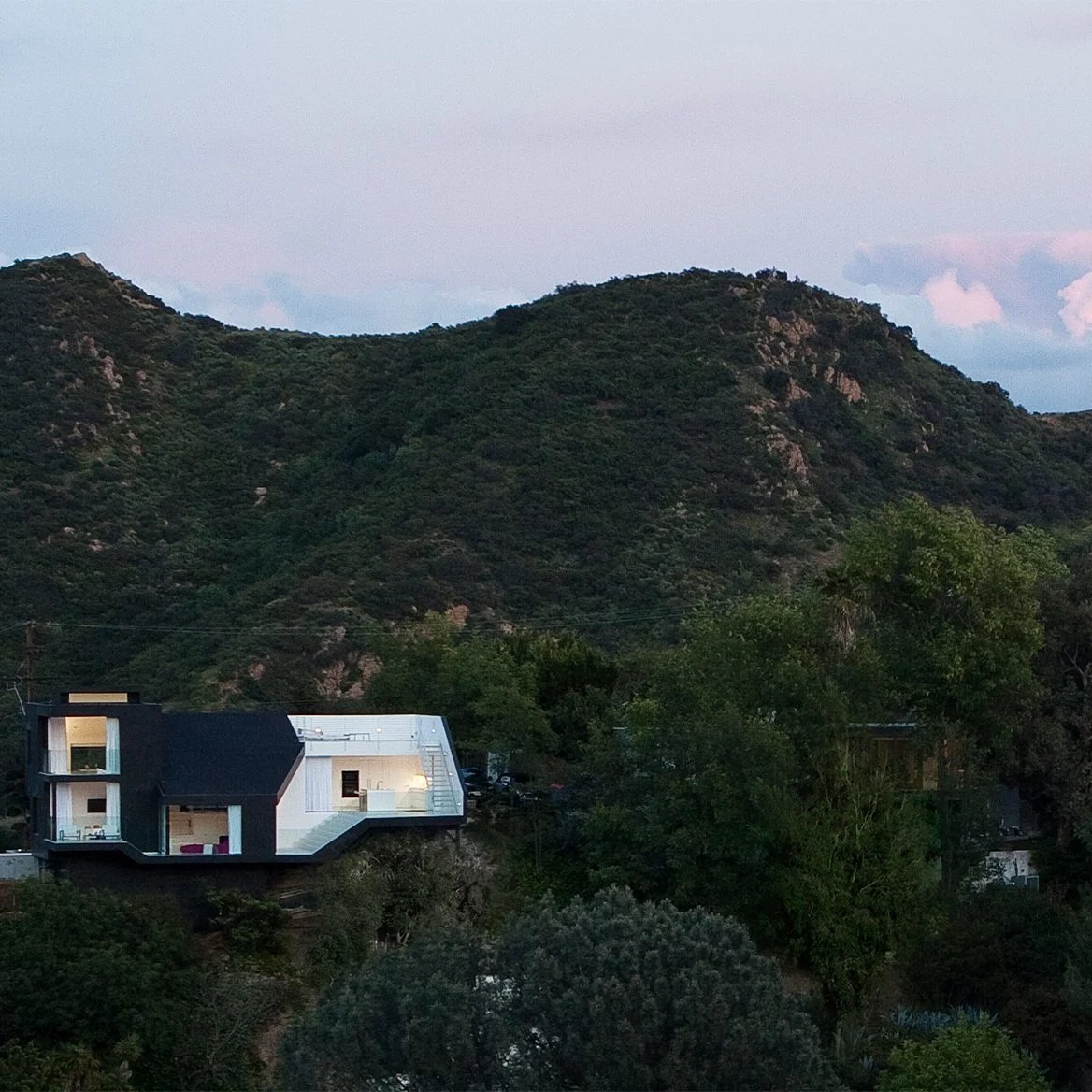
The Diamondhouse is located deep in a canyon, set against a severely sloping hillside. The building geometry was developed in direct response to hillside code parameters and articulated to provide maximum space in, around and on top of the modestly scaled building.
The material treatment of the house developed from natural elements found on site. The facade pattern is rendered with laser-cut aluminum panels, which are then anchored to the base building with steel clips. The panels are light, porous, and capable of reflecting and refracting the available daylight. At night, recessed lighting placed behind the panels will allow the building to glow from within like a lantern. The diamond filigree patterning does not follow the building walls or apertures, but generates its own logic of sequencing and scaling, creating a dynamic relationship with the base building geometry and with the natural canyon environment.
As a continuity of the building facade system, the retaining walls and rooftop concrete floor reflect the same diamond pattern used on the main volume. The concrete is embossed with the variously scaled pattern by adding a rubber insert to the formwork. In this way the pattern repeats and reflects across diverse conditions, producing multiple effects of light, shadow and shape in the experience of the building and its immediate surroundings.
FordBrady was built as a vaudeville theater in the 1920's, which was then converted to a Chinese language cinema in the 1940's, and has now been converted into 12,500sf lofts and neighborhood retail spaces serving the emergent art scene in Chinatown.
Natural light enters the project through a 2,200 square foot courtyard cut into the former dark box of the theatre. This new courtyard serves as the main gathering space to the complex and links the various spaces to adjacent streets. The courtyard facade is made of operable resin impregnated plywood panels alternating with vertical fixed glass panels. The operable wall calibrates the perception between the indoor/outdoor and private/public spaces in the project. Looking from inside towards the courtyard, the vertical frames capture thin slices of the outdoor activity. When the solid panels are completely opened the interior loft space becomes contiguous with the exterior courtyard.
The primary loft was created by terracing the sloping floor of the original auditorium space. The resulting multi-level showroom, living and sleeping spaces are defined by new white forms set within the existing roof and red brick walls of the theater. The ceiling and exposed wood trusses are continuous over the enclosed service volumes, maintaining the scale of the original theater space from every vantage point.
The Mhouse is an artists' work/live/gallery complex located in the arts district of Venice Beach, California. The conceptual framework for the building took the form of two interlock- ing L-shaped volumes, one dedicated to the art studios and one for domestic functions, configured around a central courtyard — the new focal point of the artists' compound.
The painter's studio required a large, raw space with high ceilings and abundant natural light and ventilation. Facing the courtyard, the painter's studio flows into the courtyard space through a double height glass garage door and can be opened on the opposite side for indoor/outdoor painting. Support spaces and galleries wrap around the courtyard and link the painter's studio to the living spaces. A red stair leads to the master suite, a series of decks and a rooftop atelier with ocean and mountain views.
The building is oriented on the site to maximize passive cooling during the summer and in the winter radiant floor heating warms the spaces. Recycled fly-ash was used in the concrete floors throughout and the galvalum cladding has 80% recycled content. These metal panels were used almost exclusively on the exterior of the project, as roof, wall, soffit, canopy — providing continuity between adjacent surfaces to reinforce the concept of the work/live compound as inter-related and inter-dependent elements.
The Schönberg Park Apartments are designed around the idea of living amongst the trees and the picturesque landscape outside of Bern, Switzerland. The building forms were abstracted from local typologies — Villa, House, Barn — and configured on the site to carefully deflect around and thread between the existing trees on the site. Differences in plan and elevation allow for both privacy and views to the Park from every apartment, and also for the neighbors across the lane maintain a direct connection to Schönberg Park.
The glazing is proposed with an imprint of the trees which acts like a light drapery on the building, filtering the sunlight to interior spaces in the manner of tree canopies over-head. From the outside, the patterns will enter into a visual relationship with the existing trees and register on different facades at different scales.
Other local materials and forms were transformed and utilized for the project: traditional Bernese roof forms clad in ceramic tiles, operable exterior shutters and cobblestones that were to be used for all the ground level flooring. Schönberg Park developed as a regrouping of forces: the buildings accumulate into form and construction, and then disperse into pattern and landscape.
The Vhouse fits into its canyon site like a pavilion. Four bearing walls are oriented perpendicular to the hillside and follow the site lines of the v-shaped lot. The folds and cantilevers of the roof geometry are articulated to respond to specific site conditions: turned down at the street edge to create privacy; folded up above the bearing walls to gain light from the sides; and sloped up again at the rear of the site to open the interior spaces to the hillside through full-scale glass.
The courtyard is planned as an outdoor room around which the different types of day and nighttime living are organized. Direct access from the open kitchen allows for outdoor dining and entertaining throughout the year, while secondary openings in the bearing walls allow for access from the bedrooms in the mornings.
Minimal detailing and materiality is indivisibly bound to the architectural concept. The bearing walls are clad in wide redwood planks that wrap continuously from exterior to interior. The non-structural infill facades are made of fine redwood slat panels alternating with open glass zones. The exposed wood framing overhead aligns with these alternating solid/void areas, generating a series of continuous lines that articulate the interior space, extend into the courtyard and frame the landscape beyond.
The site plan for the Za'abeel Park Observation (ZPO) Tower is organized according to a traditional Islamic geometric pattern found in the regions' decorative arts. At the scale of the plaza, this pattern takes the form of the granite paving, lines of grass, flowers and trees, and a ribbon of water that draws one in and through the base of the ZPO Tower. This same pattern at a larger scale delineates four distinct landforms around the base of the tower, creating different pathways and approaches to the base as well as providing required program spaces for parking, conference center, children's library and service areas. A flexible conference center for one hundred persons is located along a pathway to the North of the tower, with access to the lake, Za'abeel Park and a garage located within a second landform. A Children's Library is located in a smaller landform adjacent to the main tower entry, and a fourth landform shielding the site from highway traffic is provided for mechanical and service spaces. Landscape: Coen + Partners – Shane Coen, Stephanie Grotta, Bryan Kramer, Travis VanLiere Structural Engineering: Thornton Tomasetti - Steve Ratchye PE SE, senior associate
The Islamic pattern is rendered in different grasses and plantings at a larger scale over these landforms, with the intention that they are accessible for the public to climb upon and to sit to watch the crowds or the lights of the tower above. The landforms serve to both frame and guide the activity around the entry points to the tower and also to create a gradual transition between the scale of the ZPO Tower and the larger Za'abeel Park as it extends to the North and West.
The intention is for the ZPO Tower to be built as a net zero energy tower. Several hundred square meters of thin film photovoltaic solar will clad the horizontal planes of the upper petal roofs and the Southern, Western and Eastern exposures of the tower. The main program areas are located beneath landforms with green roofs to reduce solar gain. Geothermal cooling and ventilation will serve these program areas. All the water used on the site will be recycled, and the majority of the building materials will come from recycled sources. Estimates are that the solar energy alone will generate enough electricity to illuminate and power the building.
The ZPO Tower has been developed in plan, sections and elevation with reference to both the Islamic pattern developed in the site planning and the geometric qualities of certain desert flowers native to the region. There are six tubes set in a 30m diameter, with three inner tubes and three outer tubes. The inner tubes comprise the circulation system for the tower; one containing the elevators, one containing an open stair and one containing an enclosed, fire-rated emergency egress stair. These three inner tubes are shaped according to their function and also to provide lateral structural support for the dynamic configuration of the three outer tubes.
The three outer tubes are articulated to describe a 270-degree rotation around an invisible cylinder defined by the original Islamic pattern. At the base the tubes open and expand into “petals” of open air steel structure with a continuous cladding of monocrystalline solar panels at the Southern and Western exposures. As the three outer tubes rise they begin to open and expand into larger petals that cantilever out 70m in each direction at the top of the tower. Inside these upper petals are dramatic spaces that contain a café and six interconnected indoor and outdoor observation deck areas on two levels.
The structure of this tower is comprised of a steel diagrid system, interlaced with additional steel members that follow the lines from the pattern at plaza level of the site. The intention is that the structural pattern, derived from traditional Islamic patterns, becomes the expression of the ZPO Tower. At times this structural pattern may be more open as building loads are dispersed, and at times they may be so dense that they resemble the traditional mashrabiyya screens found in the regional architecture. This braced frame structure is laterally reinforced every 30m by horizontal diaphragms connecting between three and six tubes in any one instance. At the base and top transitions bent moment frames support the horizontal diaphragms. The geometric organization of the tower results in a form that naturally sheds wind and allows it to pass through and around the aerodynamic upper forms. An 8m diameter wind dampening mass is located at the center of the upper tower to further compensate for any wind loads.
The petals at the top of the tower are oriented towards specific views and directions that resonate with both the past and future of Dubai. The first petal is aligned with Mecca, to the Southwest of the project site. Moving clockwise at the top of the ZPO Tower, the second petal is directed toward the old town of Deira, a neighborhood of traditional souks, mosques, old fortress walls and wind towers. From the observation deck in the third petal of the tower one surveys the changing skyline along Sheikh Khalifa Bin Zayed Road.
The canton capitol city of Liestal, Switzerland aspired to connect an outdated train station that is used by thousands every day to the old medieval quarter and city center. The two areas are currently separated by parking lots, factories and a 20-meter elevation change. If the historic core was represented by rings of development around the first medieval church, the train station area was to be a modern, straight vector of velocity.
Landscaped bridges, a lake in lieu of a parking lot and a series of narrow profile apartment buildings that filtered and directed ones view from the train station toward the old town connected these two irreconcilable areas. Hotel and bank blocks across from the station were lifted off the ground to create visual transparencies to the old town, allowing the exterior urban spaces to penetrate the buildings and the buildings to become public bridges between the rail station and the main town.
Other program elements such as artists housing and community schools were developed with their cores and circulation zones along the rail and large expanses of glass on the opposite side opening to views and landscape. Older buildings were redefined and reinvigorated as museum spaces and artists studios. Reworking the urban fabric of this growing city with enhanced public spaces and carefully articulated buildings serves to connect the periphery of the city to its visual and historic center.
201 S. Santa Fe Avenue
Suite 202
Los Angeles, CA 90012
Tel 213 625 7002
Fax 213 625 7004
Haupstrasse, 60
Sissach - BL 4450
Switzerland
Tel (41) 061 971 9090
Fax (41) 061 971 9099
T 213 625 7002